border

border

Tuesday, September 30, 2014

Your Brain, Technology and the State of Your Soul

Do you ever:
  • …find yourself frustrated because you went online to get some small piece of information and ended up spending an hour you never intended?
  • …experience anxiety if you don’t check immediately when you hear a ping for a text, email, or phone call?
  • …sit down to read a book and find yourself impossibly distracted?
  • …set aside a time for quiet prayer but feel so antsy you can’t get anything out of it?
  • …constantly feel as if the more you try, the further behind you will be with all the things clamoring for your attention?
If you answered yes to any of these, you are completely normal, but what you may not know is why.  Simply put, over the past ten or fifteen years, your brain and mine have been undergoing a silent restructuring as a result of modern technology and our ubiquitous connections to the virtual world. 
As I shared in last week’s post, our brains are incredibly adaptive, hosting a circuitry that can be wired and rewired over the course of our lives as needed.  This is really good news as we consider that we don’t have to be shaped by past experiences, but can alter the way our brain cells connect in order to change not only how we think or feel, but how we behave. 

But here’s the bad news.  Our brains basically work on a “use it or lose it” principle.  And because we spend so much time mentally connected—to the internet, television, smartphones, tablets etc.—our brains are getting really good at things like skimming for pertinent information, rapid shifts between topics, accessing knowledge on an as-needed basis, and surface-level analysis.   


Because modern technology increasingly rewards this kind of activity, we have become mentally dependent upon it—our brains in essence, require it.  In his book, The Shallows: What the Internet is Doing to our Brains, Nicolas Carr likens us to lab rats who continually push a lever to get a reward of some sort of social interaction or intellectual nourishment.


What's Really at Stake?
Why is this bad news, especially in light of all the benefits technology has produced?  There are dozens of concerns that are causing neuroscientists, educators, doctors, and psychologists to speak out, but perhaps the most critical is that because of the way the brain works, we are losing our capacity for things like reflection, contemplation, meditation, or even deep thinking or reading.  

In other words, as spiritual people, we are in danger of wiring out our ability to connect with God and other human beings in profoundly meaningful ways.  Carr writes:
As the time we … spend hopping across links crowds out the time we devote to quiet reflection and contemplation, the circuits that support those old intellectual functions and pursuits weaken and begin to break apart. The brain recycles the disused neurons and synapses for other, more pressing work. We gain new skills and perspectives but lose old ones.
There are a plethora of books and articles addressing this.  In her book Alone Together, Clinical psychologist Sherry Turkle explains why we find it so hard to focus in quiet moments, noting that when we try to reclaim concentration, we are “literally at war with ourselves.” 


The Coming Dark Age?
Another journalist actually contends that we are entering into a new dark age, soberly warning:
Amid the glittering promise of our new technologies and the wondrous potential of our scientific gains, we are nurturing a culture of social diffusion, intellectual fragmentation, sensory detachment.  In this new world, something is amiss…The way we live is eroding our capacity for deep, sustained, perceptive attention—the building block of intimacy, wisdom, and cultural progress.  (Distracted: The Erosion of Attention and the Coming Dark Age, p. 13 by Maggie Jackson)
Interest in the threat of modern technological advances is not some passing fad, but one that is fueling research from every angle across a vast network of disciplines, from academia to medicine to business to science.   

The Church's Strange Silence 
Yet, while a growing cadre of cultural commentators is sounding the alarm, the church seems to be strangely silent. This is perplexing.  Of all those who are affected by this brain restructuring, it seems we as Christ-followers have the most to lose.  How will we experience transformation into his likeness if we can’t seem to engage in practices designed to renew our minds (Romans 12:1-2, Ephesians 4:23)?  How will we come to know him more intimately, something Jesus pointed to as the nexus of eternal life (John 17:3), if we find ourselves incapable of sitting with him in solitude, engaging in meditation upon his Word or contemplation of His person?

Let me quickly point out that I love technology and I am not intimating that we need to go back to some simpler time.  That is not going to happen, and in fact, the pace and quality of life as a result of this technological revolution is only going to become more complex at exponential rates.

But I do want to pose the question—do the tools of technology control you, or do you control them?  Are you a servant to their demands, or do they serve your purposes?  


Your Technology Control Checkup
In case you're not sure, I have put together a brief 10-question survey for you to do a personal check up.  When you finish the survey, go back through and add up the points on each page from the far right column to see your total.  Then check here to see how you did (by the way, I scored 33 out of 50, so obviously I have some work to do!).   Click here for the survey--it can only handle 100 people, so take it soon!  
The point I am trying to make here is simply that we need to be aware of what is taking place and start being proactive about how we invest our time and energy.  

The upside of what we now know about our brains is that not only do we have the ability to alter our this recently developed destructive circuitry, but the Spirit of God is committed to helping us in our weakness (Romans 8:5-11; 26-27).  It will some take time, persistence and discipline, but we can recapture these critical capacities of reflection, quietness and attentiveness.  We can’t afford not to—for ourselves, our children, and the culture in which we live.

Coming next: Simple steps to recover critical spiritual capacities

To order any of my books, or Nicolas Carr's What the Internet is Doing to Our Brains, visit my store by clicking here. 

Friday, September 19, 2014

How Christmas, 1956, Wired My Brain

It was Christmas and I was a precocious four-year-old, squirming restlessly on the floor, hell-bent on helping mom and dad figure out the best spot in our tiny living room for the spindly evergreen we’d just purchased from the local drugstore.  Surrounded by siblings and boxes of ornaments and lights, I chattered on mindlessly, tossing out ideas like confetti until suddenly out of nowhere a Christmas light came flying my way.  I looked up wide-eyed just as it hit me in the forehead, and was shocked to see that my mom had thrown it.  Before I could respond, dad jumped up, grabbed the tree and stormed out of the house, yelling: “We just won’t have a tree this year.” 

I didn’t remember that story until 14 years later in a freshman psychology class where we were tasked with writing about our earliest memories.  What came back to me then wasn’t just the experience, but the way I had felt in the days that followed.  I remembered how I’d watched my parents closely, hoping for a sign that things would be okay, that life would return to normal.  The relief I’d experienced when I came upon them hugging in the hall one morning was palpable, even those many years later.  The next time I was home from college I shared this with my mom.  The backstory she related upended my perceptions about what had really happened.  More about that later.

Life Experiences and the Brain  
My experience as a four-year-old illustrates something neuroscientists have discovered about the brain in the past few decades, which is that life events—both large and small— and our emotional response to them, have the capacity to “wire” our brains in specific ways that end up shaping our behavior, often without our even realizing it.   

Here’s my admittedly simplistic take on how this works:  There are gaps called synapses between each of the billions of neurons (cells) our brains hold.  Within these gaps, neurotransmitters carry electrical impulses and chemicals flow, enabling each brain cell to communicate with thousands of others.  In addition, the neurons themselves are often changing, growing new branches and discarding others, all as a result of life experiences.   This activity goes on every moment of every day, not only regulating how we see the world but affecting our behavior in it.  This is the way that memories are formed, and in essence is what distinguishes our mind from that Jello-like substance we call the brain.    As neuroscientist Dr. Susan Greenfield explains:
Each time you hear a noise, blink at the light, have a conversation, or cut another piece of cake, some small, imperceptible and unspectacular modification to the configuration of the brain occurs, and we interpret the world in a slightly different way. (Private Life of the Brain, p. 54)
Because certain powerful hormones rush through the synapses during traumatic experiences, these tend to affect us more tangibly, creating enduring changes in our brain circuitry and in turn, our way of relating to our world.   For me, that Christmas memory wired my brain in such a way that I began to live with a hyper-vigilance lest I make another mistake with even more dire consequences.  I won’t even begin to describe the behaviors this has produced over the years, but suffice it to say my saint of a husband has had to embody an inordinate amount of patience in the face of my compulsion to control things.

The Really Good News
But that leads to the real point of this particular blog post—the good news—which is that, as I noted last week (click here to read), no matter how old we are, our brains are still malleable.  This means that we do not have to remain victims of our circumstances, products of our upbringing or even our latest failures, but instead can choose to participate in altering the structure of our brains so that we can live differently.  Regardless of how deep-seated our unhealthy behaviors seem to be, we have the capacity to change them permanently by redesigning those neuro-pathways through new ways of thinking. 

The exciting thing is that this reality, one that science is only beginning to grasp, was revealed long ago by our Creator, who so fearfully and wonderfully made each one of us.  Again and again, Scripture calls us to change our minds so that we can be transformed.   Ephesians tells us to get rid of our old ways by being renewed in the spiritof our minds, while Romans calls us to be transformed by the renewing of our minds, and in 2 Corinthians Paul describes this process as tearing down strongholds, which happens as we take our thoughts captive.  

Of course, these are not new principles for Christ-followers, but many of us are finding hope and a fresh sense of destiny in realizing that when it comes to our brains, we can become what neuroscientists refer to as “neuroplasticians.”  As Dr. Caroline Leaf suggests, our role is to partner with God’s Spirit in order to create new brain circuitry that can change our lives for His glory.  She writes:
When you make a conscious decision to focus and direct your attention correctly, you change physical matter—your brain and your body change in a healthy way.  Purposefully catching your thoughts can control the brain’s sensory processing, the brain’s rewiring, the neurotransmitters, the genetic expression and cellular activity in a positive or negative direction.  You choose.  (Switch on Your Brain, p. 73: click here for my Book Review at a Glance)
It was while working through Dr. Leaf’s five step “Switch on Your Brain” process that my Christmas memory came up again.  I was trying to understand and overcome an internal feeling of angst that has plagued me at random times throughout my life, causing me to feel as if I needed to do something, even when there was nothing to do.  

One day as I wrote in my journal (part four of the five-step daily process), I realized that what I was really feeling was a sense that in any given situation I was responsible and must never let down my guard.  As I wrote, I suddenly realized just how and when that particular neuro-pathway had come into being.  I’ll share the process I of rewiring that I went through in another post, but for now I will just say that Jesus’ words, “You shall know the truth and the truth shall set you free,” have taken on new depths of meaning.

This is the glorious, good news.  Whatever area you may feel stuck in, however unhealthily you approach certain situations, or in whatever ways you long to walk in greater freedom and transformation, you can be your own neuroplastician!  Of course it will take some work, intentionality and discipline, but God has given us an amazing capacity to make substantive changes in how we live and think and act.

The Rest of the Story
We did have a Christmas tree that year and other than my
Me at the Ripe Age of Four
own invisible brain restructuring, life went on as before.  The backstory my mom shared with me years later was that just as we’d started to decorate the tree; my grandfather had shown up slightly drunk and she’d quickly ushered us all to our rooms so we wouldn't see him.  Meanwhile, he had proceeded to rant and rave about how ugly the tree was, insisting he was going to go and buy us a new one.  Once mom and dad finally got him out of the house and on his way home with grandmother, they brought us back in to decorate.  Of course I had no way of knowing the level of distress they must have felt in that moment, or the tension that caused them to act in ways so patently uncharacteristic.  My four-year-old brain, unable to process in any other way, simply assumed that I had caused the whole thing.  

Although it would take decades to decipher, I believe I’m well on my way to a permanent rewiring and am experiencing even now a lightness of being that is pretty wonderful.    


To read my review of Dr. Leaf's book, click here.


To visit my bookstore and order her book click here.


Coming Next: The not so good news about our brain's plasticity that every Christ-follower needs to know. 

Tuesday, September 9, 2014

This is your brain on_________________ (fill in the blank)

When I was in third grade, Miss Small, a stout, grey-haired, no-nonsense Sunday School teacher who showed up every week in the same charcoal suit and white silk blouse, stunned our entire class by cracking a raw egg into a glass of beer, soberly warning us that the egg represented our brains.  The lesson itself, if there was one to be had, was lost on us as we squirmed and snickered in awkward awe at that can of Pabst Blue Ribbon sitting there on a Sunday morning in our Southern Baptist church.  Truth be told, there wasn't an eight year old among us who had ever been in close proximity to a can of beer, much less breathed in its yeasty aroma as it bubbled and frothed its way to the top of the glass. 

Turns out, Alice Small may have been ahead of her time, at least in likening a brain to an egg.  In the mid-1980s the Partnership for a Drug-Free America launched a campaign with an ad which showed a close-up of an egg dropping into a frying pan, while a voice in the background uttered the now ubiquitous phrase: “This is your brain on drugs. Any questions?” 

Aside from the fact that the texture of a brain is more like a bowl of Jell-O than an egg yolk, these metaphors allude to a revolutionary reality that the exploding study of the human brain called neuroscience has uncovered.  Simply put, our brains are malleable, subject to change, and not hard-wired in the womb in some unalterable fashion as was once assumed.   This means that not only what we do and how we do it, or what we know and how we learn it, but every single life experience has the potential to alter the very structure of that three-pound organ that sits atop our neck, persistently utilizing 20 percent of our body’s energy, even when we are asleep.   

There is both good news and bad news in this, and in the coming weeks I will be exploring why it matters, particularly to those of us who seek to follow Christ.  Eventually I hope these meanderings make their way into my next book, so I hope you’ll come along on this journey, sharing your thoughts and questions as we go.

Over the past several days I have immersed myself in material on the brain, trying to get a layperson’s grasp of the current knowledge.  The more I have read, the more profoundly I have felt my finiteness.  It’s as if I’m trying to navigate some vast foreign country without a compass, plundering across an exotic terrain that holds mystery and intrigue, symmetry and precision, while the best mapmakers in the country lament the immense swaths of yet uncharted territory.

While high school biology taught me brain parts—from the stem to the cerebellum, the amygdala to the hippocampus and hypothalamus, the basal ganglia to the cerebral cortex—these seem pedantic in light of the discoveries of the past few decades.  Scientific understanding of how the brain works is increasing exponentially—more knowledge has been accumulated in the past 50 years than the previous 5000.  

Although scanning limitations have relegated neuroscientists to observing a piece of the brain so miniscule that it could fit on the end of a straight pin, that small fragment has revealed a world of activity a bit like New York City in the height of rush hour.  Here’s just a smattering of what they've discovered:

  • Your brain hosts 100 billion neurons (nerve cells) roughly the same as the number of stars in the Milky Way, each one unique, resembling a branch of a tree and exquisite in its complexity. 
  • These billions of branch-like neurons communicate endlessly and intricately with each other, like friends talking on the telephone. 
  • The synapses that connect these neurons throughout our brain measure upwards of 100,000 miles.
  • It appears  that our thoughts, perceptions and memories shuttle along these synapses like racecars at speeds of up to 250 miles per hour, escorted by neurotransmitters such as endorphins to reduce pain and increase pleasure, adrenaline to keep us alert and balance our blood pressure, or serotonin to regulate our appetite and mood (to name a few).
  • When we go to sleep at night, this activity continues as our brain sets about the task of pruning.  Neurons grow new branches and lose old ones, while synapses may be strengthened, shrunk, created or destroyed. This is the changing nature of our brains.

If this seems slightly overwhelming to you as it did me, then you are in good company.  Dr. Sebastian Seung, professor of computational neuroscience at MIT, shared his own emotional response to this study to which he has devoted his life:
As a scientist, I am not supposed to talk about my feelings.  “Too much information, professor.”  But may I?  I feel curiosity and I feel wonder, but at times I have also felt despair.  Why did I choose to study this organ that is so awesome in its complexity that it might well be infinite? It’s absurd.  How could we even dare to think that we might ever understand this?  [italics mine]
For me, this gives new meaning to the reality that we humans are created in the image of God.  I can only conclude, as did the Apostle Paul:
Oh the depth of the riches and wisdom and knowledge of God!  How unsearchable are his judgments and how inscrutable his ways!  For who has known the mind of the Lord, or who has been his counselor?...For from him and through him and to him are all things.  To him be the glory forever.  Amen (Romans 11:34-36)

Next week:  Why your brain’s malleability is good news for the soul. 

Resources:
The Astronomist: A Cubic Millimeter of Your Brain. (2011, July 27). Retrieved from http://theastronomist.fieldofscience.com/2011/07/cubic-millimeter-of-your-brain.html
Greenfield, S. (2000). The private life of the brain: Emotions, consciousness, and the secret of the self. New York: John Wiley & Sons.
Horstman, J., (2009). The Scientific American day in the life of your brain. San Francisco: Jossey-Bass.
Seung, S. (2013). Sebastian Seung: I am my connectome TEDTalk - YouTube. Retrieved from https://www.youtube.com/watch?v=Dl850CUX4Rw&noredirect=1
Zimmer, C. (2014, February). Secrets of the Brain [e-magazine]. Retrieved September 9, 2014, from http://ngm.nationalgeographic.com/2014/02/brain/zimmer-text

Thursday, June 19, 2014

What to Do When You Don't Know What to Do (otherwise known as the Post-PhD blues)

Getting my PhD--May, 2014

Last year my kids gave me a poster that listed the things PhD students wish people would stop asking.  At the top of the list was the proverbial, what are you going to do next?  Truth be told, I wish I had a dollar for every time someone has asked me that in the past several weeks.  But really, I wish that I had an answer, some duly impressive response that would prove I didn't just waste three and a half years of my life.  I don’t have an answer.  In fact, all I really have to go on is a few words I think I heard the Spirit whisper several months ago about how I was going to love God’s plan, one I might add, that He seems to have no intention of revealing to me just yet.

So what do you do when you don’t know what to do?  Maybe you can relate.  Perhaps you have hit an impasse in a relationship, or your kids are driving you nuts and it’s only the first week of summer, or your job feels like an albatross around our neck and you desperately want out, or you need a better living situation but keep running into dead ends, or a family member is ill and doesn’t seem to be improving and you wake up every morning with a vague sense of dread because you just don’t know what to do.  And no matter how much you pray or read Scripture or seek wise counsel, the answers don’t come and the path forward doesn't materialize.  At times it seems as if God himself has left the building. 

Thankfully, I've been here a few times over the course of my life and while that doesn't necessarily make it easier, it does mean that I've learned something about what to do when I don’t know what to do.   In fact, there are really just three simple practices that have become my “go to” when I have no idea what God is doing. 

PRACTICE NUMBER ONE: REMIND YOURSELF OF WHO GOD IS
By this, I don’t just mean think about it once in a while, but make it a habit, a pattern, a daily-and throughout the day-
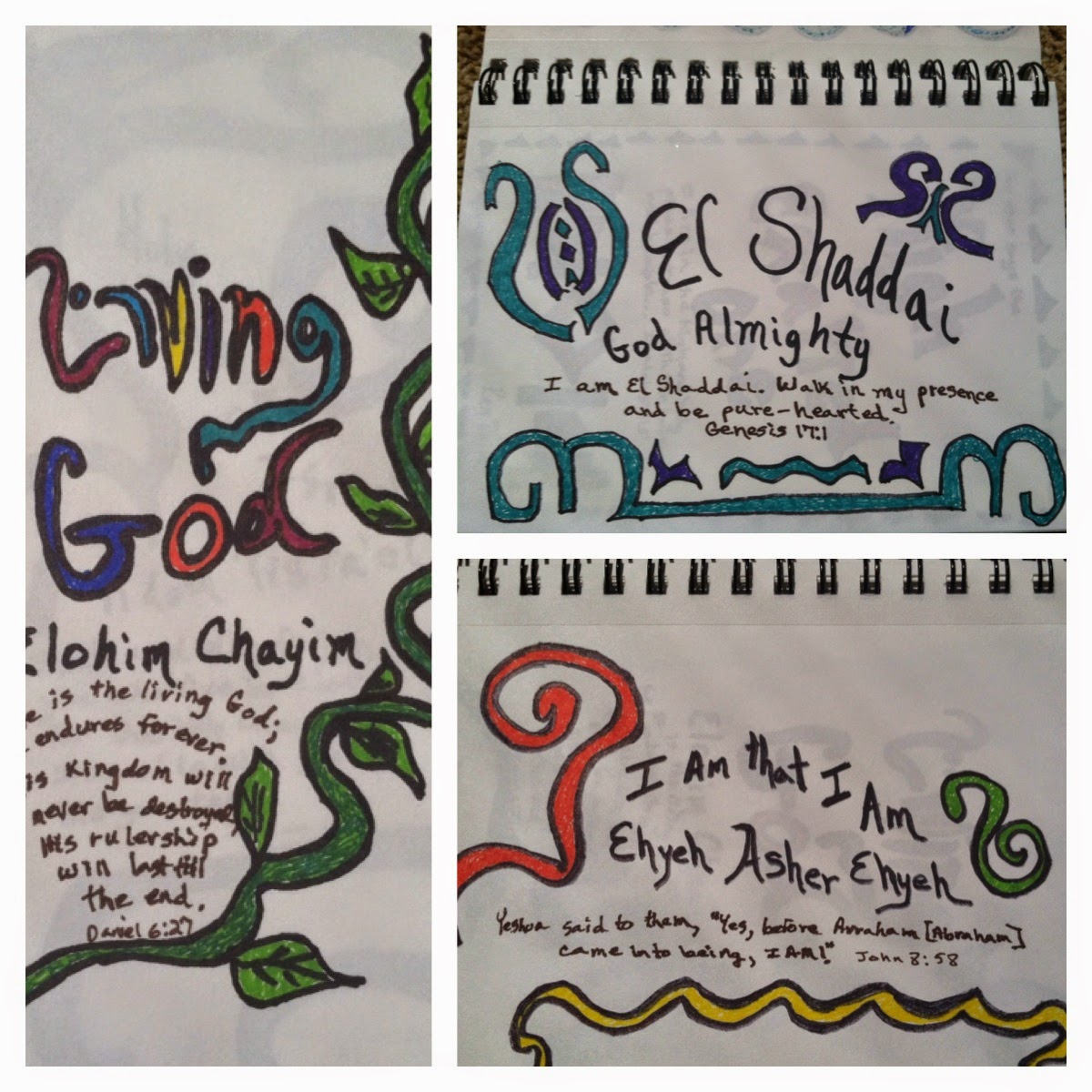
practice, to focus on what you already know about God.  For me, this means starting my quiet time each morning by directing my attention to Him, regardless of how I feel.  There are so many ways to do this, but lately I've been working through a book on the Hebrew names of God.  I choose one, read the Scriptures that apply, and then just doodle a picture about it, all the while reminding myself that this is who I serve, that this is the God who chose me, who loves me, and who knows the end from the beginning.  Truly there is nothing as comforting and reassuring to me than to just remember God’s character, His attributes and His ways. (Click here for more information on praying in color). 

PRACTICE NUMBER TWO: REMEMBER WHAT GOD HAS DONE  
This too must be a pattern of life.  During this season, every day I try to reminisce by looking back and focusing on a time when God faithfully met me at my point of need.  It might be some huge event, like when he surprised us with our second son Jonathan after years of infertility, or it might be something more urbane like the encouraging email I got from a stranger who’d been blessed by one of my out-of-print books.  The point is that we seem to be hard-wired to forget how good God has been to us, and it takes a concerted effort to pause, take stock of our past, and just remember.


PRACTICE NUMBER THREE: DO WHAT YOU CAN
  This simple truth can be incredibly freeing and helpful.   In my case, I didn’t want to apply for a job because I was afraid I would get ahead of God and miss His plan.   I think I assumed that I would wake up one day and voila! Here was my future on a platter!  But that didn’t happen, and after wrestling with God over this, I sensed that He wanted me to just do one little thing each day, whether turn in an application, talk to a trusted reference, or update my LinkedIn profile.   Because I seek to set my heart towards Him daily, I do not have to worry about missing His will, or taking a wrong turn, or screwing things up on my own.  He is the one who opens and closes doors, and as I trust Him and take steps each day in the best way I know how, He will fulfill His plan, in His time.

So that’s it—three little practices that are getting me through this very strange season in my life.  I can’t say that I have it down, and in fact there are some days when I am overcome with discouragement and sense the seeds of distrust trying to find fertile soil in my soul.  

But although I don’t seem to be any nearer to knowing my future than I was a week or a month ago, I haven’t yet thrown in the towel.  Instead, I just try to do those three things consistently--remind myself of who God is, remember how faithfully He has led me in the past, and do what I can, which, by the way, is the reason I'm writing this blog. 


ENGAGE IN A 10 MINUTE GUIDED REFLECTION ON THIS BELOW:


Saturday, April 12, 2014

Holy Week and a Little White Lie

It really wasn’t my fault, at least that’s what I told myself.  After all, Joe was the one who had asked me to get him one of those free cones that McDonald’s gives to children who eat there.  Escorting our three older grandkids and carrying the baby, I had gone to get them while he brought the car around.  When I asked for four cones, the girl behind the counter looked us over, quickly doing the math, and said, “But there are three kids.” 

That’s when I lied.  Without blinking, or for that matter, even thinking, I said, “One is for the baby.”  Eyebrows raised, the girl began making the cones as I looked away, mortified to
see that nine-year-old Marni was watching.  I couldn’t wait to get out of there.  Seething with frustration, I slammed the car door, letting Joe have it over the fact that these cones were for kids and he should never have asked for one.  I won’t go into the details of that unsavory conversation, but suffice it to say he had the upper hand since I was the one who had lied. 

I was miserable the rest of the evening, and in fact, tossed and turned all night, humiliated that I could so easily fabricate a story over something as insignificant as an ice cream cone.  The next morning as I sat before the Lord, I asked for forgiveness, which I’d already done numerous times throughout night.  It didn’t help.  Even though I knew that my sins were all forgiven, I couldn’t get past the fact that I’d fallen so far, so fast.   

I called Marni that afternoon to apologize, telling her that what I had done was wrong, trying to explain that lying is not only bad for us, but grieves the heart of God.  In reality, I wanted more than anything to be able to give her some reasonable excuse for my behavior, but there was none.

Over the next few days I saw more clearly that what bothered me most was the fact that I hadn’t gotten it right, that once again I’d failed a self-imposed standard of perfection that has plagued me my whole life.  If I’m perfectly honest, I don’t want to be the kind of person who can lie about an ice cream cone…but I am.

That experience took place a few years ago, but I thought of it this week as I meditated on Jesus’ final hours and read this passage:  Christ redeemed us from the curse of the law by becoming a curse for us—for it is written, “Cursed is everyone who is hanged on a tree.”   Earlier Paul had explained that the “curse of the law” applied to anyone who "does not abide by all things written in the Book of the Law, and do them” (Galatians 3:10-13). 
    
The reality is that for me, and for every human being, the curse of the law means we have to get it right—not some of the time, not most of the time, not even 99 percent of the time, but every single time.  No mistakes.  No sins.  No white lies or anger or greed or immorality or coveting or judging—the list goes on.  

The curse is that no matter how hard we try, no matter how often we succeed or how good we get, there isn’t a person in the world who can be certain they will never find themselves standing in the line at McDonald’s as I did that day, lying about an ice cream cone. 


That Jesus redeemed us from the curse of the law is one of a plethora of beautiful truths we must ponder as we gaze upon the crucified Christ this holy week.  In taking on our sins for those terrible agonizing hours at Golgotha, Jesus became a curse for you and for me so that we might walk in the freedom and joy that comes from knowing we never have to get it right again.  What a wonder.  What a Savior.  Have a blessed Easter.


Tuesday, March 25, 2014

The Parable of the Ubiquitous Ferns

I had no idea what I was up against when I set out to get rid of those pesky ferns that had spread through my garden like predators on the hunt during my three and a half year excursion into academia. Several hours later I wasn't even close to getting the job done.  For every handful I pulled, five or six more lurked in the shadows, taunting me with their persistence.   


and
     the 
         piles 
                grew...
                            along with my aching back. 


I collapsed in sheer exhaustion days later when I finally yanked on that last leafy stem,  my body hurting in places I never knew existed. Still, looking out at the now the barren hill, I was filled with a pleasant sense of accomplishment.  

My reverie was short-lived, however.  At dinner that night Joe mentioned in passing that if I wanted to keep those ferns from coming back, I needed to make sure all of the roots with their bountiful propagating balls were dug out and discarded.


        that's 

             when
                   the 
                       real
                  battle
        began.


Not only were there scores of tenacious tentacles burrowed deep in that soil, but hundreds of brown balls had left the landscape looking like the aftermath of a muddy hailstorm.  So I collected and shoveled and pulled and wrestled like a mad-woman, swearing under my breath at the fern gods, and if I'm honest, my beloved husband (what was he doing all this time while my head was buried in books?)
                            
                          One 
               bucket 
        full 
and
         I 
              wasn't 
                      even 
                            half-way
                                      done.

Feeling desperate I even paid my grandsons a nickle each to collect those rootballs, which they did with glee for about five minutes, earning a hefty sum before they tired of the task.
I knew that having come this far, there was no turning back, so I bravely soldiered on, painfully aware that Dr. Rhodes or not, no one else was going to do this job for me. 


 A funny thing happened as the hours stretched into days. Gently the Lord began to write a parable on my heart about those persnickety plants.  It happened as I was pulling up a cluster of new growth and realized it had no root balls.  I couldn't believe how easily it came out of the ground, and lamented to myself how I wished they could all be this way.  That's when my little hill became a metaphor for my soul.
You see what had frustrated me most about the whole fern adventure was that I knew that had I simply spent a few minutes dealing with those wayward stems each week, I would never have gotten in this predicament.  Indeed, that garden cleanup might have lasted an hour or so rather than an entire week.

Once the Spirit began to drive this home, every single stem, root, or hairy string of balls I excavated from that hard ground reminded me of what happens when I fail to care for my soul, when I let things go, when, out of sheer neglect, I wreak havoc on the most important part of my being (never mind my family and friends). 

Here's the thing.  It really doesn't take long to tend our souls, to give them the attention they need so that the beautiful fruit of God's Spirit can take root as He cultivates the soil there.

But what frustrating fallout when we fail to take that time!  I know, we all intend to get to it, but what we don't realize is that with every delay, things like those seemingly innocuous sins, unhealthy attitudes, bad habits, inappropriate actions, or unwise decisions are slowly seeping into our souls, spreading out their tentacles, securing their nasty hold.  Then one day we are miserable and we sorely feel our sorry state, but the last thing in the world we want to do is take the time to clean up that mess.  The enormity of the task seems debilitating, to say the least.


Deuteronomy 4:9 puts it simply: "Only give heed to yourself and keep your soul diligently."  Truth be told, it does take a measure of diligence to attend to our souls, but my friend, have you considered the alternative?  May the parable of the ubiquitous ferns serve us all as a ready reminder in the days to come.


NOTE: If you would like to be on my email list to receive occasional devotionals and book news, you can sign up on my website by clicking here. 


Monday, March 10, 2014

A Personal Note and the Beginning of Lent

a personal note...

This week my life took a dramatic turn when I successfully defended my doctoral dissertation and became Dr. Rhodes after four arduous years of study.  During that time devotionals from the Soul at Rest website have been few and far between  I hope that will change now that I have a little more time on my hands. 

I wanted to write now because we are in the beginning of Lent, and this is such a special time.  My first experience with meditating on the passion narratives was almost 20 years ago, and I can honestly say that every year since has taken me deeper into the wonder of what the cross really means.  After that first experience, I wrote:  God beckons us to gaze in awe at what we see on Calvary’s mount. He challenges us to bathe in the wonder of such love until we lay ourselves down, weary with unworthiness, yet cleansed and renewed in the healing stream of blood shed there.

I look forward to keeping in touch.  If you have any suggestions or questions, please feel free to email me at tricia@soulatrest.com.
---------------------------------------------------------------------------------------

about lent

Often the Lenten season creeps up on us as Protestants, and we wish we had been a little more spiritually prepared.  My philosophy is that it is never too late to start.  While Lent officially began on Wednesday, March 5, you can still make plans to set aside a period of time--days or weeks--for focus, spiritual renewal, and a fresh vision of crucified love.
Some ideas to help you focus: 
  • Fast in some way--a meal a day, a full day each week, eating out, pleasure foods etc.--and use that time to read the passion narratives reflectively (for guidance on how, click here
  • Let go of media--TV, facebook, twitter, instagram, web surfing--an evening or a day a week, or even the entire season, and use the time to pray and read. 
  • Work through a devotional like Contemplating the Cross by yourself, with your family, or in a small group (The publisher no longer allows me to make these available online, but click on the title for a sample devotional and ordering information. 
  • Set aside a block of time each week to focus spiritually. Use it to get away from the busyness of life to read, pray, and contemplate Christ's death (Catholic churches are almost always open and available for quiet meditation).
These are just a few thoughts. May you be drawn to greater intimacy with Christ during this very precious time of the year.